Showing posts with label ICT. Show all posts

Sunday, 25 May 2014

Exploring Youthful Innovations to Transform Agriculture in Africa via #AfricaDayAgric Chat

The African Union (AU) observes its founding date, 25th May, as "Africa Day" every year. This is a national holiday in many African countries set aside to reflect on how far we have come in pursuit of continental unity and various aspects of life. Earlier, the AU declared 2014 as the Year of Agriculture and Food Security, and the diaspora team of GhanaThink Foundation saw this as the perfect opportunity to engage youth on their role in transforming the agricultural sector.

Yesterday a Google + hangout discussion hosted by the team explored the challenges, innovations and opportunities in the African agricultural sector. The event, hosted by Jemila Abdulai and Kirstie Kwarteng featured youth panellists drawn from research, business, ICT and other contexts within the agricultural space. Joining the discussion were David Aduama, Alloysius Attah, Acheampong Atta Boateng, Edison Gbenga, Dr Joy Odimegwu, Sidney Rockson and Worlali Senyo. Their rich insights were shared with viewers in various parts of the world through the Diaspora Camp YouTube channel. You can follow what was discussed through the video below:


Inputs were made into conversation by the wider online community via the #AfricaDayAgric hashtag on Twitter and other social media platforms. The moderators masterfully increased interactivity by highlighting core points made and questions asked by the Twitter audience. A summary of the Twitter conversation is also available through the GhanaThink Storify account, thanks to Ato Ulzen-Appiah.

I left the discussion thinking of: (i) the role of education in giving youth skills and making agriculture attractive and (ii) strategies needed to withstand the negative effects of climate change on agriculture. If you have any thoughts on these, kindly drop a comment and let's discuss.

The #AfricaDayAgric chat is part of the new DiasporaCamp Online series, and hopefully we would have conversations on other topics of importance to African youth, home and abroad. What topics do you think need to be explored?

Monday, 7 April 2014

The Citizen Science Approach to Research: Report from GW4 Workshop, Bath

Source: thinkprogress.org
The idea of harnessing the collective or community input for a project is quite appealing to my African mind. Grassroots involvement fosters group ownership and often leads to better results. Movements such as GhanaThink, BloggingGhana and Enactus ride on the numbers and efforts of its members. When applied to science, public participation aids data collection and organisation, research design, and facilitates greater understanding of scientific phenomena. The active involvement of volunteers or "lay people" in the scientific enterprise, "citizen science", is a fast-growing paradigm in the scientific community and has the same essence as open source, open data and civic participation movements. It has wide applications ranging from social science research, through ecological studies, to unravelling the mysteries of the wider universe. I recently had the fortune to be part of a citizen science workshop organised by the United Kingdom's GW4 Universities at the Bath Royal Literary and Scientific Institution, (BRLSI).
We were welcomed by Dr Helen Featherstone of University of Exeter who gave a brief intro of the day's activities. Dr Robert Simpson from University of Oxford, in the first presentation, gave an overview for the need and benefits of citizen science, drawing examples from the Zooniverse project.
He made an interesting point on validating crowdsource data- data contributed by the most accurate and least accurate volunteers are equally important because of the consistency. Thus you can tell whether the data coming in is accurate or inaccurate.

Dr Erinma Ochu from the University of Manchester then explored the topic from a social science perspective, with examples from the Sunflower Experiment and other projects. Here's a key point she made:
One of my favourite parts of the day was the structured networking session where the participants interacted about how they use citizen science in their work. In short three minute spells, I learnt briefly about projects such as mathMETicsIfOnly, and BodyTrack.

Next was a panel on citizen science case-studies featuring Lisa Austin (Bath, IfOnly), Alexander Todd (Exeter, CliMathNet), Dr Emma Rich (Bath, Citizen Journalism), Dr Jaap Velthuis (Bristol, HiSparc), and Dr Sarah Perkins (Cardiff, Project Splatter).

Panel discussion on GW4 citizen science projects
After the round-table, we broke for lunch amidst networking, followed by the breakout sessions. The breakouts focused on recruiting citizen scientists, methodological approaches and ethics. I was in the methodological approaches/ethics group and some of the issues raised include data ownership, blurring the line between academic and activist, limitations of institutional review processes, and citizen science governance.

Some useful technological and web resources for citizen science researchers were also shared among the group. Some of the less popular ones include Amazon Web Services (AWS), Storify, University Wiki pages, Open Street Map, Google tools (Maps, Apps, etc), Carto DB (for visualisation), Ushahidi (for crowdmapping) and Github (for open source code). 

I learnt a lot from what researchers are doing in the GW4 universities and other institutions. More than that, I enjoyed the brilliant opportunity to interact with the brains behind some really interesting citizen science projects. Hopefully we can do more with the larger public to piece together the puzzle that is life and derive better solutions for our pressing problems. Meanwhile, the conversation continues on Twitter via #GW4CS.

Friday, 7 March 2014

Afrimakers and OUWA Team up to Train the Next Generation of Ghanaian Makers

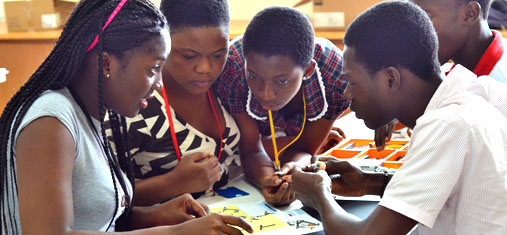
Trainees keenly engaged during the Africamakers Uganda session. Source: Afrimakers
Afrimakers project, in partnership with Open University of West Africa (OUWA) and a few others, are making further strides towards nurturing a maker movement in Ghana. Their three step strategy involves:
  1. Training facilitators to lead mentoring workshops and the community
  2. Mentoring 6 to 17 year olds to acquire the necessary problem-solving skills
  3. Showcasing innovations and networking through maker faire type events
Victor Kelechi Ofoegbu, one of the coordinators for the first facilitators workshop coming up at iHub, Accra next Monday, 10th March states:
The project aims to spark interest in young children for STEM (Science, Technology, Engineering and Mathematics) by exploring a range of hands-on experiments hands. The projects range from building paper-based electronic circuit boards, air quality control sensors, recycling old web cams into microscopes, to programming Raspberry Pi microcomputers.
This is a brilliant opportunity to improve problem-solving through open innovation in Ghana. Everyone should register and be part of it.      

Tuesday, 5 November 2013

Harnessing the Power of Digital Technology for Education in Ghana

Ghanaian high school teachers undergoing ICT4E training in Saltpond, Central Region
Information Communication Technology (ICT) can be a great enabler of learning when used rightly. For this to happen, both teachers and students must be adept at handling all kinds of gadgets and software. Ghana has a lot of promise in the digital education space, but a lot remains to be done to bring our level up to speed with global standards. My post explores five ways through which technology can be applied to enhance learning in Ghana.

Use of Tech in Classroom
A skilled teacher can apply technology in her classroom in many ways. She can run her lessons using PowerPoint or an open source alternative. This automatically allows for the integration of pictures, videos and other multimedia. Use of multimedia content increases the attention of students as their senses are fully engaged. The chalk or marker board would still be used for sketches, annotations and other classroom activities. Of course teachers in a typical Ghanaian school may not have access to a projector but it is possible in this age of proliferation of mobile devices to take initiative to get relevant images and videos on a smartphone and tablet that students can watch to enhance their understanding. A student may have the challenge of understanding the chemical principles behind the cleansing action of a detergent, but would easily pick up the concepts when shown a YouTube video of the process. I used this method to great effect.

Content Creation
There is no gainsaying that access to the Internet opens up a wealth of information for the Ghanaian learner. That said, it is often asked whether the kind of content currently online is relevant to our students and pupils. I would say not always. Inability of students to relate to the information they come across on the Internet is a barrier to their full understanding of concepts. Also, there is almost zero content available for certain subjects like Ghanaian languages. Teams of teachers and students can work together to address the dearth in local educational content problem. This creates a collaborative learning atmosphere that fosters development of critical skills such as creativity, teamwork, leadership and communication. 

App Development
The Ghanaian developer community must play their part in improving educational standards in the country. Advancements in computing and software development has resulted in the abundance of many easily accessible yet powerful open source platforms, that can be used to create educational web and mobile applications relevant to Ghanaian school children. Therefore, technologists need to work with teachers to digitize notes and test questions, and repackage them into stimulating content that students can easily interact with and learn from. Growth in the use of educational technologies in Ghana would in the long run profit software developers. However, their involvement in the sector should not be seen with purely as a business opportunity but as a social crusade as well. We need to see more projects like Paasco Africa spring up and make a difference to learners.

Student Learning Activities
The effectiveness of ICT in education is enhanced when use of relevant tools is integrated into student learning activities. Students can explore topics such as Body Mass Index (BMI) and graphs with spreadsheet software, allowing them to develop computing skills alongside subject-specific knowledge. Tasking students to deliver assignments through presentations and email enable them to pick up key work-study-life communication skills needed to thrive in the 21st century. One may think my point is basic, but a student once scanned a handwritten assignment and sent it to my inbox when I asked them to submit a group work electronically. While such a behaviour is excusable at the pre-tertiary level, the reaction would have been totally different at an institution of higher learning. My point is that we need to create the platform for the young ones to make all the mistakes now, rather than later, when much is at stake.

Creating a Web of Learning
Social media has become a reality of our modern existence as a species. Many students are distracted from their studies when they spend endless hours online connecting with their friends on Twitter or Facebook. But, this situation can be turned around through well thought out strategy. We can capitalise on the students’ interest and engagement on these platforms to serve them with educational content. This ties in with some of the points raised above. Imagine the level of excitement and the amount of learning students will experience if they were working on a YouTube video project for class assignment. Further teachers can use Facebook groups (such as Global Lab Ghana, Google + hangouts and Twitter hashtags to take class discussions beyond the classroom. This way students benefit from the insights of their colleagues and other experts from across the world. They also get to analyse issues in a more relaxed environment as compared to the traditional Ghanaian classroom setting. This hopefully will deepen their understanding and engender application.

Conclusion
We cannot hide our heads under the sand like ostriches in the information age. Ghanaian teachers need to embrace digital tools for teaching and content creation. App developers need to pay more attention to the needs of the educational sector and students must be encouraged to harness ICT to aid their learning. The steps we take today, through policy formulation and effective implementation, will inform how well our educational sector will work some few years down the line.

This post is part of Blu’s LiveBlu Forum, a social commentary on work-life balance in Ghana. Join the discussion at: http://blughana.wordpress.com/ #LiveBlu #BeLieveUme or sign up here to try turbo-charged internet powered by Blu.

Saturday, 16 February 2013

Ghana Social Media Awards Finalists List Out


The BlogCamp team recently released the list of finalists for Ghana's maiden Social Media Awards. The Social Media Awards is part of BlogCamp 2013, and is aimed at encouraging the development of more quality local content. This reinforces BloggingGhana's overarching goal of increasing the relevance of the Internet in Ghana.

After a very grueling selection process, the following blogs made the final cut for "Best Blog":
Also, nominations were made in twelve other categories, and these are  "Best Original Content", "Best Creative, Literary Short Stories, Poetry Blog", "Best Organisational Blog", "Best Technology Blog", "Best Citizen Journalism Blog", "Organisation with Best Social Media Presence", "Personality with Best Social Media Presence", "Best Business & Commerce Blog", "Best Showbiz and Entertainment Blog", "Best Lifestyle Blog", "Best Activist Blog" and "Best Photo Blog".

See the full list of nominees at blogcampghana.com. Many bloggers whose blogs made it through expressed joy and appreciation for the outcome. Some who could not make the final list were obviously disappointed.

BlogCamp 2013 will be an all-day event held on 23rd March at the Kofi Annan Centre of Excellence in ICT. Registration is still ongoing for the biggest social media event of the year, with roughly 57 tickets left. The event is organised by BloggingGhana, Ghana's biggest social media association, and supported by Intel, Fiesta, US Embassy in Accra, Google and Voltic.

Sunday, 18 November 2012

Putting Education to Work: The Role of ICT in Skills Development

The Ghana launch of the tenth UNESCO Education for All Global Monitoring Report was held at the British Council, Accra, last Wednesday 14th November. It was put together by the Accra office of UNESCO in collaboration with DFID, World Bank, Ministry of Education and the GhanaThink Foundation. The report's theme, "Youth and Skills: Putting Education to Work", is both interesting and very relevant to the times. 

Hiplife star and CEO of Lynx Entertaiment, Richie in a musical performance
A presentation by Prof Kwame Akyeampong, one of the report's authors, brought to the fore many failings of Ghana's educational system including inability of some basic school graduates to read, inaccessibility of education to the poorest, continuous low-enrollment of girls, late entry of pupils into education and lack of second-chance opportunities for school dropouts.While we thrive fairly well compared to most African countries, we're way off the mark considering our lofty developmental aspirations.

Prof Akyeampong: Investing in education and skills is good business. Every dollar invested gives ten-fold reward.
As part of the programme, six tables were set up to discuss different topics connected to the report. These were ICT and technology, The role of the private sector, An education for the world of work, Informal education and out-of-school children, Education/skills development for rural/disadvantaged women and Entrepreneurship. Each session had an expert and two or more youth leaders to coordinate  deliberations.

During the ICT and Technology session, a clear distinction was made between ICT as a school subject and ICT as a teaching and learning tool. It was noted that technology’s usefulness should not end after ICT classes but must permeate every aspect of the school curriculum.

The following challenges were noted as barriers to adoption of ICT in Education: 
  • Lack of basic infrastructure, including electricity and Internet 
  • Expensive equipment eg computer
  • Reluctance of older teachers to embrace ICTs 
  • Distraction suffered by students (as they abuse the use of technology)
 To overcome the challenges, some proposals were made: 
  • Put more attention on mobiles due to their ubiquity
  • Create synergies as different people on the table were involved in one project on the other  
  • Be more encouraging to people’s efforts. Part of OLPC’s challenges stems from lack of support  
  • Enforce the curriculum 
  • Set up rules/policy to moderate usage of technology by students
 We don’t have to try to get everything right from go since critical mass creates demand (for the resources) hence supply (by government or private sector) comes in. 

Participants shared their contacts so as to continue with the discussions and collaborate on projects they’re working on.The following projects and resources were mentioned:

Tuesday, 25 September 2012

Social Media Awards for Ghana's Online Community

BloggingGhana is introducing another first into Ghana's online world, the first ever Blog and Social Media Award! The event slated for March 2013 is generating buzz in the local web ecosystem, as this is the first time bloggers, vloggers, tweeps and facebookers will be officially recognised. Find the full press release below.

“BLOG And Social Media Awards 2013!”
Ghana’s 1st Blogging And Social Media Awards Night

We’ve all fantasized about being world-popular writers; had long conversations with ourselves in the shower; wowed the lawyer in us with the sheer wit of our arguments in the isolation of our bedrooms; calmed the storms and tsunamis of the world with Dalai Lama and Paulo Coelho. We’ve even changed policies and agenda with our very own mass followings, photoblogs, and online networks. In reality, this might not be the case, but in the world of the blogger, tweep, facebooker, everything is possible.

It’s a closed world, personal and sometimes defiant, but it has influenced, shaped, and motivated many. And here at BloggingGhana, we firmly believe it’s about time we appreciate, honour, and award some of the personalities behind the blogs, tweets, and pages that have so motivated, informed, and affected many of us.

So join us, in March 2013, to show special honour to our silent, unknown, sometimes faceless cyber and social media motivators. Yes, you, me, and she/him, at the first-ever in Ghana “Blog & Social Media Awards 2013”. If you are a blogger, tweep, facebooker, and you believe you have touched the world – really, it’s okay if you/person are not so up there, you should still make your nomination – locate yourself in the following categories:

  • Best Technology Blog
  • Best Business & Commerce Blog
  • Best Citizen Journalism Blog
  • Best Creative, Literary Short Stories, Poetry Blog
  • Best Showbiz and Entertainment Blog
  • Best Lifestyle Blog
  • Best Activist Blog
  • Best Photo Blog
  • Best Organisational Blog
  • Best Blog

Other Social Media Categories
  • Personality with Best Social Media Presence
  • Organisation with Best Social Media Presence
  • Best Original Content

Nomination Process
BloggingGhana will open up Nominations for the above listed categories in November 2012 after which an Academy and the Public will vote for the best in each category. Voting will close in February 2013 and presentation of awards will be at the BlogCamp Ghana 2013 event scheduled for March 2013.

Visit http://blogcampghana.com/social-media-awards/ then follow @BloggingGhana on Twitter, and stay locked on for updates on “the road to Blog & Social Media Awards! 2013”. There will be daily riddles, blog quotes, personality bloggers of the week, ‘Vim Series’, and other events alongside the nomination period activities. Most importantly, there might be an award here with your name on it!

ABOUT
This event is brought to you by BloGH – BloggingGhana, Ghana’s biggest organization of bloggers and social media enthusiasts. BloggingGhana (BloGh) is a group of bloggers and social media users, writing out of Ghana or the Ghanaian experience. It is also an aggregator website that collects the latest posts and tweets from our members. Since June 2011 we are a registered non-profit organization with a executive council working towards the following objectives:
  1. Serving as a forum for bloggers in Ghana to network and exchange ideas
  2. Building capacity among bloggers in Ghana
  3. Accessing new audiences for our blogs through a mutual website (aggregator) and other activities
  4. Promoting citizen journalism in Ghana
  5. Educating the general public in Ghana on the opportunities of social media

The idea of starting BloGh came out of a meet-up of bloggers on 24 July 2008.  To that first meeting, organized by bloggers Sandra Crabbe and Kajsa Hallberg Adu, eight bloggers were invited. We wrote: “we would like to bring the Ghanaian blog community together in real life! There is so much to say…about our green homeland, if Blogger is better than  WordPress, if labels are useful, how best to boost and count traffic,  what Internet cafés are fast, and of course how blogging changes your life…”


END

Media Contact:
Naa Adaku (Golda) Addo
Blog & Social Media Awards Lead – BloGH
+233(0)244828322
@GHANAmomoni
goldaaddo@gmail.com

Friday, 24 August 2012

Google Hangout Discussion on IEA Presidential Encounters

Yesterday, I took part in a Google plus hangout organised by Ghana Decides to discuss submissions from presidential candidates of various political parties in the Institute of Economic Affairs (IEA) presidential encounters series. I joined fellow Ghanaians from different locations throughout the world to discuss what we made of the submissions of the leaders of Convention People's Party (CPP), People's National Convention (PNC) and New Patriotic Party (NPP) as Ghana prepares for elections in December. The hangout was broadcast live on the Ghana Decides YouTube Channel. You can follow the discussion for yourself through this video:


Various opinions were shared, but what was clear is that people expect the IEA encounters to have little impact on the outcome of the polls (due to a perceived language barrier as the discourses were undertaken in English and that most people already made up their minds on who to vote for). However, it was agreed that the platform created by IEA has become an important hallmark of our democracy. It's relevance lies in the fact that whoever wins power will be held accountable for the pronouncements made to the people captured live on televison, radio and on the Internet. Another thing that was clear was the seeming distrust of political authority and their willingness to really bring change to the country. 

All in all it was an interesting discussion and another example of the use of social media as a tool for civic engagement in our part of the world. I look forward to another opportunity in the future to talk, not only about politics, but also about other topics I'm interested in. What do you think about the points made during the discussion? What were your impressions about the IEA Evening Encounters? What do you think are the main issues that concern the youth as far as democracy in Ghana/Africa is concerned? It'd be good to know!

Monday, 20 August 2012

Ghana's High School Students Learn How to Build Robots

Future Ghanaian engineers busy building their robots. Source: www.ashesi.edu.gh
High school students from all over Ghana were given the opportunity to sharpen their science and technology skills through the Ashesi Robotics Experience (ARX), a five-day robotics competition recently hosted by one of Ghana's most innovative universities, Ashesi University CollegeARX was also aimed at piquing the interest of students in industry-relevant careers in computer science, engineering and technology.

I could not visit the Berekuso, Eastern Region, campus of Ashesi to savour the robotics experience firsthand, but this amazing YouTube video shot by Sharifah Issaka does a good job relaying what transpired:


The experience itself, as evident in the video, was fun, not only for the particpants, but for Ashesi President Patrick Awuah Jr himself as well.


Ashesi University seems to be getting it right when it comes to practical and quality tertiary education in Ghana. I can only applaud their efforts to get Ghanaian high schoolers to develop deep analytical and problem-solving skills while wooing them to their university.

Friday, 27 April 2012

BloggingGhana Organises First Ghana BlogCamp

BlogCamp Ghana logo

BloggingGhana, Ghana's biggest group of bloggers and social media enthusiasts presents a day of workshops and networking dubbed BlogCamp Ghana 2012. I will encourage everyone who can to attend this event as I can testify to how social media has changed my worldview and improved my life. BlogCamp 2012 indeed gives voice to the new generation!

Exchange of ideas during January 2012 meeting

BlogCamp seeks to educate and inform attendees on the benefits of social media channels such as Twitter, Facebook, YouTube, Google+ and blogs. Further, BlogCamp 2012 will demonstrate how the youth can leverage the power of social media for positive social change, good governance, accountability, technology, business and education; this will ensure that there is more online content from Africa. BlogCamp 2012 will also be used to launch Ghana’s first Social Media Awards scheme, aimed at rewarding various activists and contributors to the growth of social media in Ghana. Visit the BlogCamp Agenda page for further details.

BlogCamp 2012 has been made possible through the efforts of the BloggingGhana Community and the kind support of our partners: Vodafone, Google, United States Embassy, Nandimobile, Web4Africa, Citi 97.3 Fm, Mawuli Sikanku Photography and REDD Kat Pictures.
Enter your details into the BlogCamp 2012 registration page to be part of this wonderful programme. For more information, visit the BlogCamp Ghana website or connect with BloggingGhana through Twitter, Facebook or Google +. We will be posting with the hash tags #BlogCamp12 and #BloggingGhana. Send your inquiries and we will get back to you immediately. Be part of BlogCamp 2012, Voice of a New Generation!

Wednesday, 11 April 2012

Biometric Voter Registration in Keta, Ghana: How I Registered

Ghana will be going to the polls this December to elect a new president and members of parliament. As part of preparations for the election the electoral commission (EC) is undertaking a fresh voter registration exercise using biometric technology. The adoption of a Biometric Voter Registration (BVR) system has become crucial in order to minimise electoral fraud, and to ensure that whoever emerges victor is the true choice of the people.

What is biometric registration and how will it be done? I believe the video below explains the process quite well:


I registered on Easter Sunday at the Abidjan station polling station at Tegbi near Keta. Contrary to reports of a tedious registration process, characterised by long queues, from some parts of Ghana, my experience was pretty smooth. In fact, one woman who was almost done with penning down her name was the only other registrant at the centre when I got there. It took no more than ten minutes to get my brand new voters ID card.

Going through the Biometric Voter Registration exercise at Tegbi-Keta in the Volta Region
 The staff of the EC were professional and friendly. They took the trouble to answer all my curious and probing questions. From them, I got to know that I was the thirty-second person to register on that day. They're not facing any major technical glitches. Hopefully, as the Easter festivities have ended, more people would go to register in order to participate in the national elections.

Which card is better? The old one or the new one? #iRegistered
 So, I have my voters ID card, and the power to elect our next leaders, in my hands now. There are many issues to weigh before casting that vote, before determining the direction that Ghana should go in the next four years. The conversations have began. Ghana Decides, a BloggingGhana Election project seeks to promote these important conversations on social media channels. Starting with the iRegistered campaign,  their Facebook, Twitter, YouTube, Google + and Flickr pages reveal the amazing efforts being made to engage the youth ahead of this year's elections. Hopefully the often ignored voices of youth, women, physically-challenged and other socially-excluded groups will count during the elections through their efforts.  Refreshingly, the likes of Mashable, AJstream, GlobalVoices, Ghana News Agency and the government portal are following keenly what the youth of Ghana are trying to achieve using social media.

For now, I will keep a keen eye on events as they unfold and make my choices based on the real issues, the issues that I and others around me face. Just like every other Ghanaian would do. Go and register if you have not done so yet. Like the cliche goes, "your vote is your power!"